Inside the STAR Story Builder: From Raw Notes to Panel-Ready Evidence
The STAR Story Builder turns your unstructured career experience into polished, scored STAR responses calibrated to your target APS band. Here's what it produces and how to use it.
Most candidates have more relevant experience than they can access under interview pressure. The problem isn't a shortage of evidence — it's that the evidence is stored as memories, not as structured stories. When a panel asks "Tell me about a time you influenced a stakeholder to change their position", candidates who haven't built their stories in advance reach for the first thing that comes to mind, not the best thing they have.
The STAR Story Builder solves this by turning your raw career experience into a bank of structured, scored, panel-ready responses — built before the interview, so you can practise them rather than construct them under pressure.
What You Put In
You paste your story in your own words. Unstructured, conversational, as you'd tell it to a friend — not a polished STAR response. The AI does the structuring.
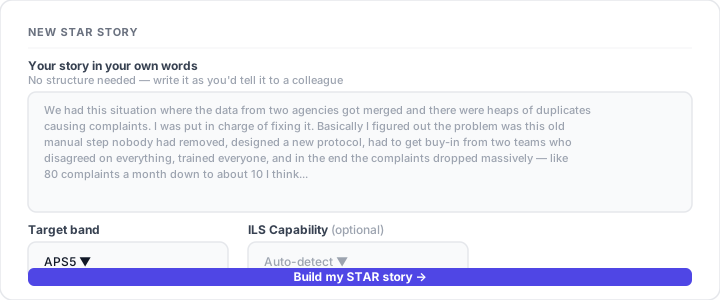
You also select your target APS band (which calibrates the expected scope and word count) and optionally indicate which ILS capability the story maps to — or leave that blank and let the tool map it automatically.
The input supports APS federal roles (ILS framework), state government roles (NSW, VIC, QLD, WA, SA, ACT, TAS, NT), and private sector. The output language and competency framework adjust accordingly.
The STAR Breakdown
The primary output is a structured breakdown of your story into its four components.
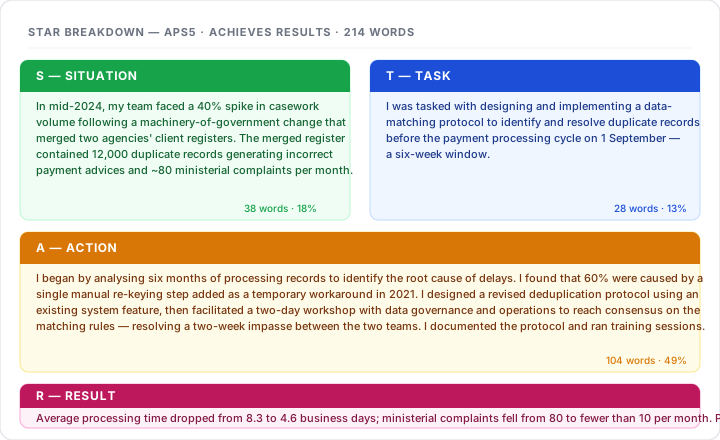
Situation (15–20% of total word count): The context, why it was challenging, who was involved, and what was at stake. Two to four sentences — enough for the panel to understand why this mattered.
Task (10–15%): Your specific accountability. Not the team's goal — what you were personally responsible for. One or two sentences using "I", with a clear deliverable or deadline where relevant.
Action (50–60%): What you personally did, step by step. Every sentence begins with "I". The tool reconstructs your raw notes into specific actions, decisions, and judgment calls — removing the "we" language that costs candidates points and replacing it with individual contribution.
Result (15–20%): The outcome, quantified where possible. Formal recognition, scale of impact, downstream effects.
The Full Prose Paragraph
Alongside the component breakdown, the tool generates a single flowing paragraph — the entire story written as a continuous piece of prose.
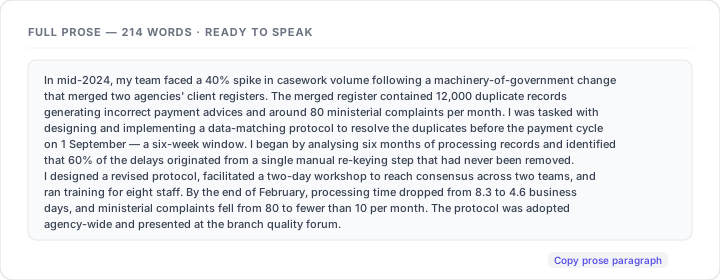
This is the version you practise speaking. APS panel responses should flow naturally — a response that sounds like it's being read from four separate sections scores lower than one that tells a coherent narrative. The prose version lets you practise delivery without the seams showing.
Word counts are calibrated to your band:
| Band | Target word count |
|---|---|
| APS3 | ~150 words |
| APS4 | ~175 words |
| APS5 | ~200 words |
| APS6 | ~225 words |
| EL1 | ~300 words |
| EL2 | ~350 words |
| SES | ~400 words |
The ILS Capability Mapping
Each story is mapped to the ILS capability it best demonstrates. If you left the capability selector blank, the tool identifies the primary capability automatically. If you specified one, it verifies the match and flags a mismatch if the story's evidence actually points to a different capability.

This matters because APS selection criteria are each linked to a specific ILS capability. Submitting a story about process improvement for a "Communicates with Influence" criterion — even a technically well-written story — will score lower because the evidence doesn't match what the criterion is assessing.
The Quality Scores
Every story is scored on four dimensions, each from 0–100:
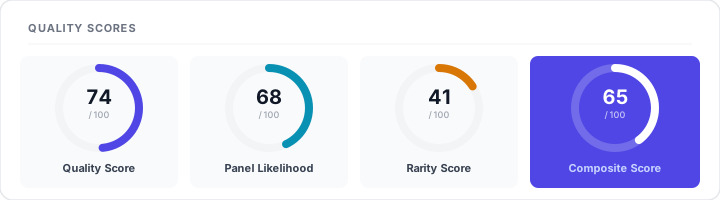
Quality Score — Writing quality: STAR completeness, specificity of evidence, appropriate use of "I", quantified results. This is the baseline — a story can't score well on the others if it scores poorly here.
Panel Likelihood — The probability that this story would score 5/5 if delivered in a real panel interview. Considers evidence strength, band-level scope, and how well the action demonstrates individual judgment and initiative.
Rarity Score — How distinctive this story is compared to the typical candidate story bank. A story about "improving a team process" is common; a story about "redesigning a cross-agency data reconciliation protocol to resolve a compliance gap" is rare. Rare stories are harder to discount.
Composite Score — Weighted overall: 40% quality, 40% panel likelihood, 20% rarity. This is the number to optimise across your story bank.
Building Your Story Bank
The value of the STAR Story Builder compounds as you build more stories. The goal isn't one good story — it's a bank of 8–12 stories that collectively cover all five ILS capabilities, so that in any interview you can select the best story for each criterion rather than recycling the same two or three.
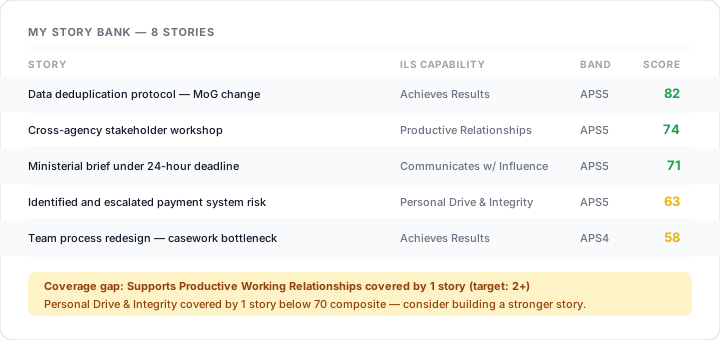
Stories are saved to your account. You can see at a glance which ILS capabilities your bank covers, which have high composite scores, and where you have gaps. A well-built story bank going into an interview means you're selecting from strength, not improvising under pressure.
Community Leaderboard
Stories you mark as public appear on the Role Ascent leaderboard, where other candidates can read and upvote them. High-scoring stories give you an ELO ranking and a public profile.
This serves a practical purpose beyond recognition: reading high-composite-score stories from other candidates in your band shows you concretely what a 4/5 or 5/5 story looks like at that level — which is more useful than any abstract rubric.
Who It's For
The STAR Story Builder is for candidates who know they have relevant experience but struggle to structure and articulate it under interview conditions. If you find yourself in panel interviews knowing you've done the relevant work but unable to recall the right story at the right moment — building your bank in advance is the fix.
Ready to put this into practice?
Role Ascent optimises your resume, builds STAR stories, and prepares you for panel interviews — tailored to the exact job description. Try every tool free, no card required.
Try every tool free →Role Ascent Team
Writing about APS careers, interview preparation, and resume strategy for Australian Public Service applicants.
Related articles