Inside the Career Assessment: Your ILS Readiness Score and 90-Day Plan
The Career Assessment analyses your resume against the APS ILS framework, tells you which band you're genuinely ready for, identifies your capability gaps, and produces a 90-day plan to close them.
Most APS employees applying for a promotion have a rough sense of whether they're ready. What they lack is a structured, objective view of which capabilities are strong, which have genuine gaps, and what specifically they should be doing before their next application.
The Career Assessment provides that view. It reads your resume against the APS ILS capability framework, scores your readiness for a target band, maps your capability profile, and produces an actionable 90-day preparation plan — specific enough to follow, not so generic that it's useless.
What Goes In
You paste your resume and select a target APS band. If you're not sure which band to target, you can leave the band selector blank and the assessment will recommend one.
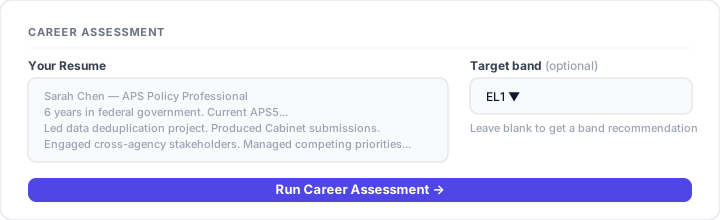
No job description required — this assessment is about your general readiness for a band, not your fit for a specific role. (For role-specific fit, use the Resume Rewriter against the job description.)
The Readiness Score
The first output is a readiness score: a single integer from 0–100 representing how well your current resume demonstrates the capabilities and scope expected at your target band.
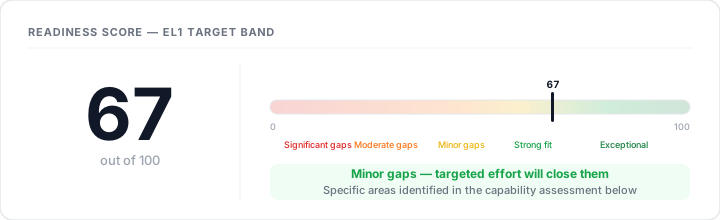
The score bands:
| Score | What it means |
|---|---|
| 0–39 | Significant gaps — the resume does not yet demonstrate sufficient evidence at the target level |
| 40–59 | Moderate gaps — 6–12 months of targeted development recommended before applying |
| 60–74 | Minor gaps — specific areas need strengthening; applications viable with preparation |
| 75–89 | Strong fit — refinement and polish will improve success rate |
| 90–100 | Exceptional fit — the resume clearly demonstrates capability at or above the target band |
The score is derived from the capability assessment below — it's the synthesised number, not the starting point.
The Recommended Band
If you left the band selector blank — or even if you specified a target — the assessment recommends the band it judges to be the best fit for your current resume.
This recommendation is accompanied by a rationale: a paragraph explaining what in your resume supports the recommendation and why, if applicable, a lower or higher band is suggested.
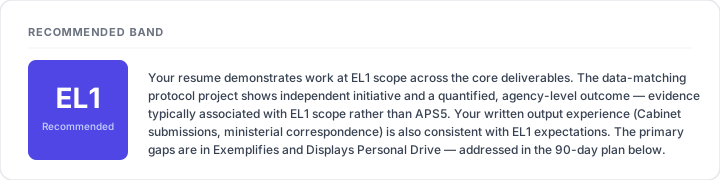
Candidates sometimes discover here that they're applying below their actual level — particularly career-changers from private sector, Defence, or academia who don't realise their experience maps to a higher APS band than they assumed.
The Capability Assessment
The core of the assessment is a structured review of your resume against each of the five ILS capabilities:
- Achieves Results
- Supports Productive Working Relationships
- Exemplifies Personal Drive and Integrity
- Communicates with Influence
- Displays Personal Drive and Integrity
For each capability, the assessment produces four things:
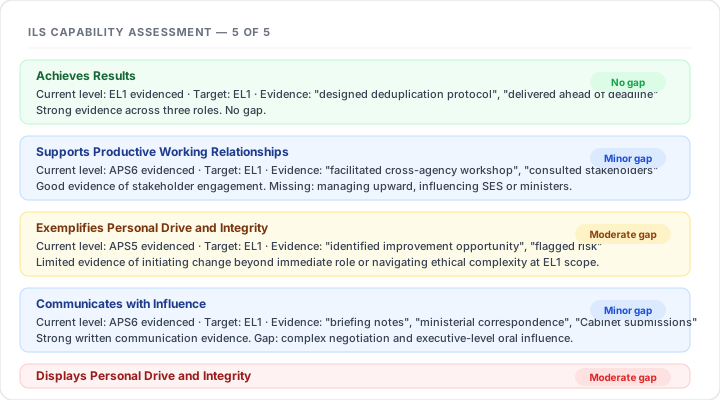
Current level evidenced — the APS band your resume currently demonstrates for this capability. Your resume might show APS6-level achievement but only APS4-level stakeholder engagement, depending on your role history.
Target level required — what the target band requires for this capability.
Evidence found — specific quotes or paraphrases from your resume that the assessment identified as supporting your capability level. These are the sentences that did the work in your resume.
Gap description and severity — a plain-language explanation of what's present, what's missing, and whether the gap is none / minor / moderate / significant.
A typical output for a candidate applying for EL1 might show:
- Achieves Results: current EL1 → gap: none
- Supports Productive Working Relationships: current APS6 → gap: minor
- Exemplifies Personal Drive and Integrity: current APS5 → gap: moderate
- Communicates with Influence: current APS6 → gap: minor
- Displays Personal Drive and Integrity: current APS5 → gap: moderate
That tells you immediately where to focus your development energy before applying.
The 90-Day Plan
Based on the capability gaps identified, the assessment generates a structured 90-day development plan. It's organised by week, with a focus theme and a set of concrete actions for each period.
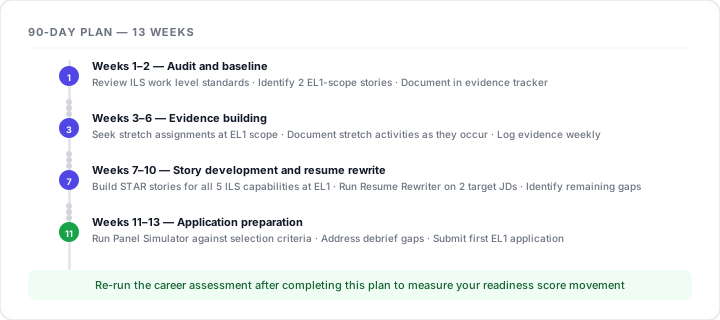
A plan for the candidate above (moderate gaps in Exemplifies Personal Drive and Displays Personal Drive) might look like:
Weeks 1–2 — Audit and baseline
- Review your current resume against the EL1 work level standard for each capability
- Identify two specific roles or projects from your history where you demonstrated above-APS6 judgment or initiative
- Document the full STAR story for each
Weeks 3–6 — Evidence building
- Seek out stretch assignments that produce evidence at EL1 scope — specifically opportunities to shape approach or scope, not just execute
- Document each stretch activity in your evidence tracker as it happens
- Ask your manager for one project where you take full accountability for the methodology, not just the delivery
Weeks 7–10 — Story development and resume rewrite
- Build STAR stories for all five ILS capabilities at EL1 scope
- Run the Resume Rewriter against two relevant job advertisements to calibrate your language
- Identify any capabilities still underrepresented and prioritise those
Weeks 11–13 — Application preparation
- Run the Panel Simulator against a target role's selection criteria
- Review debrief scores and address identified gaps
- Submit first EL1 application
Each action is specific and executable — not "develop your leadership skills" but "take full accountability for the methodology on one project and document the decisions you made."
The Evidence Tracker
Connected to the career assessment is the Evidence Tracker — a simple log where you capture evidence of capability development as it happens.
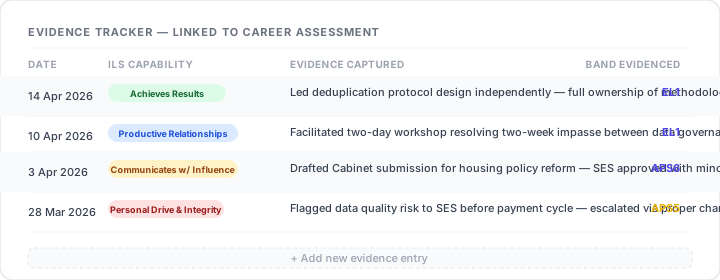
The 90-day plan tells you what evidence to capture each week. The tracker is where you record it — the project, what you did, what the outcome was, which capability it demonstrates. By the time you're ready to apply, you have a documented evidence bank, not just a memory that something happened.
Re-Running the Assessment
The assessment is designed to be run multiple times. Run it now to get your baseline. Run it again in three months after following the plan and adding new experience to your resume. The readiness score movement tells you whether your development activity is translating into demonstrable capability — or whether you need to adjust your approach.
Who It's For
The Career Assessment is for APS employees who are thinking about promotion and want a structured view of where they are now and what specifically to do before applying. If you've been passed over for EL1 applications and received only generic feedback, the capability breakdown will usually surface what the assessment panels were seeing that the feedback didn't say.
It's also useful for new entrants to the APS who want to understand how the ILS framework applies to their prior experience — particularly those coming from the private sector, Defence, or academia who may not know which capabilities their background maps to.
Ready to put this into practice?
Role Ascent optimises your resume, builds STAR stories, and prepares you for panel interviews — tailored to the exact job description. Try every tool free, no card required.
Try every tool free →Role Ascent Team
Writing about APS careers, interview preparation, and resume strategy for Australian Public Service applicants.
Related articles