Inside Interview Prep: Predicted Questions and Pre-Built STAR Answers
Role Ascent's interview preparation tools predict the questions your panel is likely to ask, then build STAR-structured answers drawn from your actual resume. Here's what you get.
APS panel interviews are more predictable than candidates expect. The panel has a list of selection criteria. They must assess each criterion. The questions they can legally ask are limited by merit-selection rules and the ILS capability framework. This means a well-prepared candidate can anticipate most of what they'll be asked before they walk into the room.
Role Ascent's interview preparation tools operationalise this: they generate the questions your panel is likely to ask, then build STAR-structured answers drawn from your actual resume.
Part 1: Interview Question Predictor
What It Takes
You paste the job description. You select the target APS band. That's it.
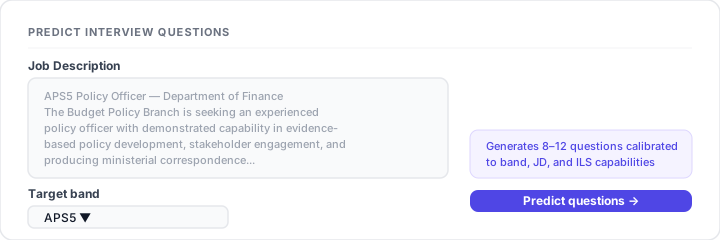
The predictor reads the job description, extracts the selection criteria and the ILS capabilities they map to, and generates 8–12 questions calibrated to the band and role type.
What It Produces
Each question comes with four pieces of metadata:
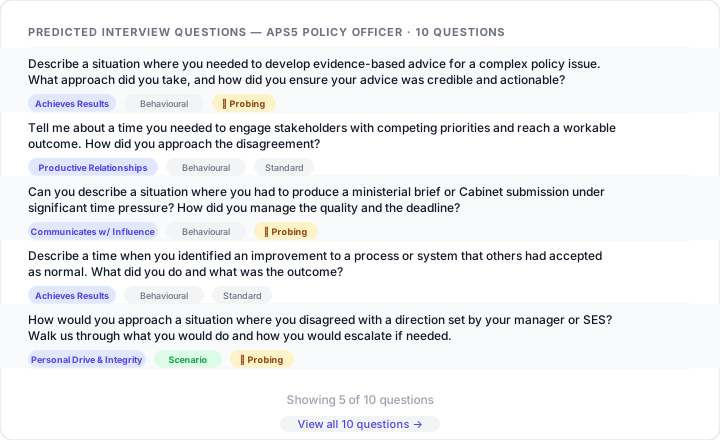
The question itself — phrased exactly as a panel member would ask it. Not "tell me about leadership" — "Describe a situation where you had to influence a senior stakeholder to change their position on an issue. What approach did you take and what was the outcome?"
ILS capability — which of the five ILS capabilities this question is assessing. This tells you which STAR story from your bank to use — and which criterion the panel will be scoring you against.
Question type:
- Behavioural — "Tell me about a time when..." (most common; assesses past behaviour as a predictor of future behaviour)
- Scenario — "How would you approach a situation where..." (assesses judgment and reasoning)
- Technical — role-specific knowledge questions (common for specialist APS roles)
Difficulty — Standard or Probing. Probing questions are designed to expose weak answers: they assume you've already given a behavioural response and push for detail you might have left out.
Reading the Question List
A typical output for an APS5 Policy Officer role might include:
- 4–5 behavioural questions covering Achieves Results, Communicates with Influence, and Supports Productive Working Relationships
- 1–2 scenario questions covering Exemplifies Personal Drive and Integrity or Displays Personal Drive and Integrity
- 1–2 technical questions about policy development process, evidence frameworks, or ministerial correspondence
- 2–3 probing follow-ups likely to be asked if initial answers are thin
This maps almost exactly to how a real APS5 panel operates. The prediction isn't perfect — every panel is different — but knowing the likely question set lets you prepare the right stories rather than preparing for everything.
Part 2: STAR Answer Builder
Turning Questions Into Answers
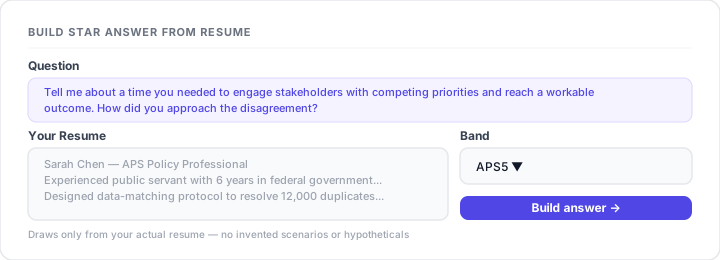
Once you have your predicted questions, you can select any question and ask the STAR Answer Builder to construct a response drawn from your resume.
You paste your resume (the same one you used for the rewriter, or any version). You select the question to answer. The builder constructs a STAR response using only the experience that's actually in your resume — no invented scenarios, no hypotheticals.
What It Produces
For each question, you get a full STAR-structured answer:
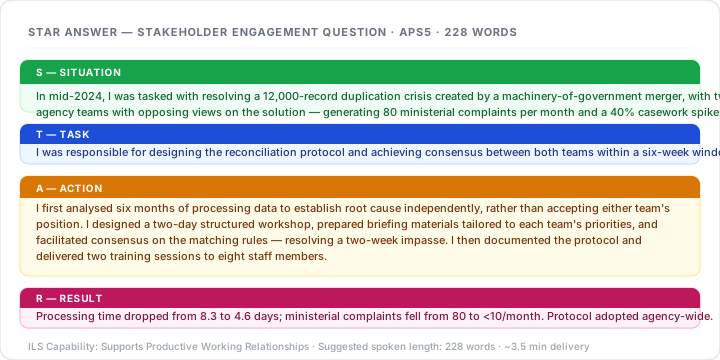
Situation — A specific context from your work history that's relevant to the question. The builder selects the most appropriate example from your resume rather than using a generic placeholder.
Task — Your specific accountability in that situation.
Action — What you personally did — in "I" language throughout, with specific decisions and steps, not generalisations.
Result — Quantified where your resume provides data, otherwise the most specific outcome available.
Suggested word count — The target length for verbal delivery, calibrated to your band:
| Band | Spoken word count |
|---|---|
| APS3–4 | 150–200 words |
| APS5–6 | 200–250 words |
| EL1 | 200–320 words |
| EL2+ | 250–400 words |
ILS capability — Confirmation of which ILS capability the answer demonstrates, so you can verify alignment with the question.
Working Through Your Question Set
The typical interview preparation flow:
- Generate your predicted question set from the job description
- For each question, build a STAR answer from your resume
- Review each answer — does it draw on the right experience? Is the action section specific enough?
- Practise delivering the prose version of each answer aloud
- Run the Panel Simulator to pressure-test your answers under interview conditions
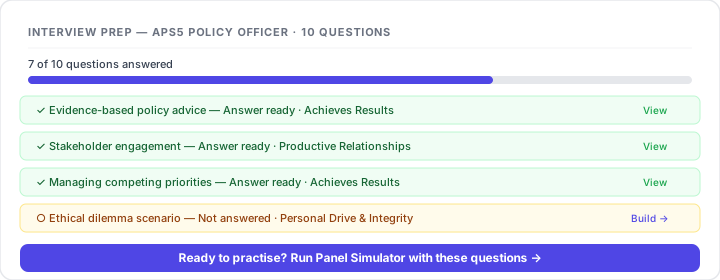
By the time you walk into the panel, you've seen each predicted question, you have a prepared answer for it, and you've practised delivering it. That's the preparation gap between candidates who score 2–3/5 and those who score 4–5/5.
The Difference From Generic Prep
The interview questions a generic tool generates are category-level: "Tell me about a time you worked in a team." They're not wrong — panels do ask that — but they don't tell you whether the panel will probe the teamwork question or the stakeholder management question, or whether you should lead with your policy example or your process improvement example.
Role Ascent's predictor reads the actual job description. It knows whether "Supports Productive Working Relationships" is weighted heavily in this JD or whether "Achieves Results" is the primary capability. The question set it generates reflects that — more questions on the capabilities that appear repeatedly in the JD, scenario questions where the role requires complex judgment, technical questions where the JD includes technical requirements.
The STAR Answer Builder then draws from your actual resume rather than producing a generic template. The answer it builds is about your work history, your specific situations — which means it's something you can actually learn and speak to, rather than a placeholder you have to replace entirely.
Who It's For
Interview prep is for candidates who've made it to the interview stage and want to arrive prepared rather than hoping for the best. If you've been shortlisted but haven't made an offer from a panel, this is where to start — most shortlisted candidates have adequate written applications; the selection happens at interview.
Ready to put this into practice?
Role Ascent optimises your resume, builds STAR stories, and prepares you for panel interviews — tailored to the exact job description. Try every tool free, no card required.
Try every tool free →Role Ascent Team
Writing about APS careers, interview preparation, and resume strategy for Australian Public Service applicants.
Related articles